Forget Less by Reviewing Right Before You'd Forget
Spaced repetition beats the forgetting curve by spreading your reviews across growing intervals instead of cramming them all at once.
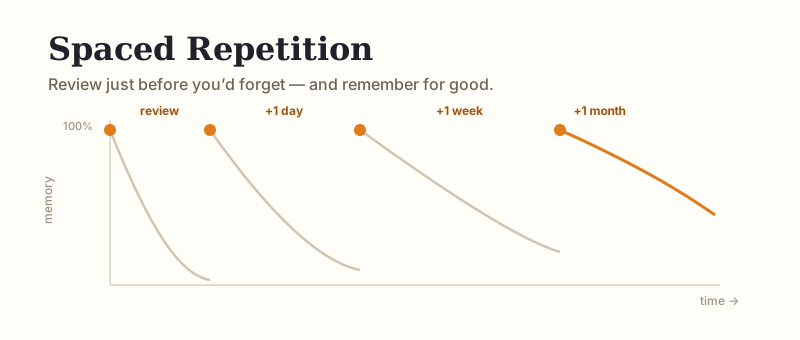
You studied a chapter perfectly on Monday and forgot half of it by Friday. That's not a weak memory — that's normal, and spaced repetition is the proven fix.
What it is
Spaced repetition means reviewing material at growing intervals — say after 1 day, then 3 days, then a week, then two weeks — instead of reading it many times in one sitting. The idea grew from psychologist Hermann Ebbinghaus, who mapped the forgetting curve: memory fades fast at first, then more slowly.
Each well-timed review flattens that curve, so the fact stays longer each time.
Why it works
Reviewing just before you'd forget forces your brain to work to retrieve the answer — and that effort is what strengthens the memory. Easy, immediate review does little; slightly difficult recall does a lot. This is called the spacing effect, one of the most reliable findings in learning research.
Cramming, by contrast, fills your memory like a bucket with a hole — quick to fill, quick to empty.
How to use it
- Studies: Make flashcards — a journal entry on one side, the rule on the other; a definition front, the meaning back. Review them on a schedule, not all at once.
- Studies: Use a simple box system. Cards you get right move to a "review later" pile; cards you miss come back tomorrow. Free apps like Anki do this automatically.
- Studies: Plan revision across the term, not the night before. Touch each chapter again a few days after first learning it, then again a week later.
- Work: Learning a new skill or software shortcut? Practise it briefly today, again in a few days, then next week — it'll become second nature.
- Work: Keep a running list of names, terms, or client details and glance over it on a spaced schedule before you actually need them.
- Daily life: Memorising a speech, a recipe, or vocabulary for an exam abroad? Short, spaced sessions stick far better than one long marathon.
Five minutes of review at the right moment can save an hour of relearning later.
Don't repeat more — repeat at the right intervals, and let time do the remembering for you.
Learn it free on ACES
Interactive notes, videos and quizzes for Plus One & Plus Two Accountancy, Business Studies and Economics — no login, no fee.
Start learning →